
Leading Into 2026: Five Priorities for Staying Out of the Upside Down
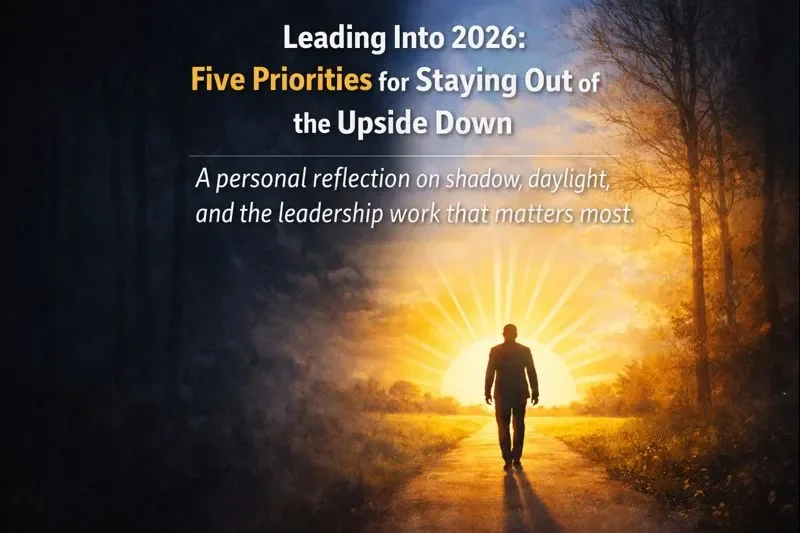
Here are my five priorities for 2026.
They are not flashy. They are not complicated. They are not new.
They are also the difference between me living in the Daylight or drifting back into the Upside Down.
Most years, when I write goals or priorities, I’m tempted to make them bigger. More ambitious. More impressive. This year, I resisted that urge. I went back to basics. And I realized something that probably won’t surprise anyone who knows me well.
Most of these didn’t originate with me. They came from my Dad.
Every year I can remember, my Dad had the same steady set of priorities. They didn’t change much. He didn’t reinvent them every January. He just kept showing up and working them.
Be healthy.
Be organized.
Be patient.
Be empathetic.
Be a finisher.
I’ve spent a lot of my life trying to carve my own path, to be my own kind of leader. But the longer I lead, the more I see how true a simple leadership truth really is.
People become like their leader.
That’s true for organizations. It’s true for families. It’s true for teams. And it’s true for me. I realize it more every day.
Whether I like it or not, I’ve been shaped by watching how my Dad lived and led. These priorities are part of my wiring now. When I ignore them, I feel it. When I honor them, everything works better.
In my soon-to-be-released book, The Upside Down Leader, I talk a lot about the difference between our Shadow Mission and our Daylight Mission. These five priorities live squarely in the Daylight. When I’m at my best, they are present. When I’m not, they are usually the first things to go.
1. Be Healthy
When I’m in my Daylight Mission, I take my health seriously.
Not in a performative way. Not in an all-or-nothing way. In a real way.
Physical health. Mental health. Emotional health. This is the foundation. Everything else sits on top of it.
When I’m healthy, I sleep better. I think more clearly. I respond instead of react. I make better decisions. I show up with more energy and less edge.
When I’m not healthy, everything feels harder than it should. Small problems feel like big ones. Big problems feel overwhelming. I get short. I get distracted. I start living in my head instead of in the present moment.
Leadership does not start with strategy. It starts with self-care.
That’s something I used to resist. It felt selfish. It felt indulgent. It felt like something I’d get to once the work was done.
The truth is, the work is never done.
Leaders who don’t work on themselves first eventually ask their teams to carry what they refuse to address. That’s when things start to crack.
Being healthy in 2026 means making time for movement, even when I don’t feel like it. It means paying attention to what I’m putting into my body. It means protecting quiet time. It means noticing when stress is building instead of pretending I can power through it forever.
In the Upside Down, I neglect all of this. I skip the basics. I tell myself I’ll get back to it later, and later rarely comes.
Daylight leadership starts with health. For me, it always has.
2. Be Organized
When I’m organized, I get things done.
It’s that simple.
I don’t procrastinate. I don’t avoid hard conversations. I don’t let emails pile up because I don’t want to deal with them. I do what I say I’m going to do.
Organization is not about being rigid or controlling. It’s about clarity. It’s about creating space so my brain isn’t carrying a thousand open loops at once.
When I’m organized, I trust myself more. Other people trust me more, too.
In leadership, trust is built in small moments. Following through. Being prepared. Closing the loop. Showing respect for other people’s time.
When I’m disorganized, I tell myself stories. I convince myself I’m just busy. Or creative. Or operating at a higher level.
The reality is simpler. I’m avoiding structure because structure requires discipline.
In the Upside Down, disorganization becomes a way of life. I start a lot of things. I move fast. I chase ideas. But nothing quite lands. Loose ends pile up. Stress builds quietly in the background.
In Daylight, organization becomes an act of integrity.
For 2026, this means clearer systems. Better boundaries. Fewer commitments and more follow-through. It means honoring my calendar and my word.
3. Be Patient
Patience is not a strength of mine. Anyone who knows me well knows this.
When things don’t move fast enough, I feel it in my body. When people don’t respond the way I expect, my irritation rises. When plans stall, I want to push harder.
Sometimes that drive is useful. Sometimes it’s destructive.
When I’m patient, I remember that timing matters. That growth takes time. That not everything is on my schedule.
I’m reminded that most meaningful things unfold slowly. Trust. Culture. Change. Healing.
In leadership, impatience often disguises itself as urgency. We convince ourselves we’re pushing for results when really we’re reacting to discomfort.
When I’m patient, I don’t lean into anger when things don’t go my way. I pause. I breathe. I remind myself that frustration is often a signal, not a command.
The world does not bend to my timeline. It never has.
In the Upside Down, impatience turns into sharpness. I interrupt. I push. I assume intent that isn’t there. I create pressure where none is needed.
In Daylight, patience becomes a stabilizing force. It creates safety. It allows others to show up fully. It allows me to listen instead of rushing to fix.
This is work for me. Daily work.
4. Be Empathetic
Empathy does not come naturally to me.
That’s hard to admit, especially as someone who teaches leadership. But it’s true.
Empathy is something I must practice intentionally. I must slow down. I must try to see myself in others. I must imagine walking in their shoes, even when it would be easier not to.
The best leaders I know are empathetic leaders. Not because they avoid hard decisions, but because they understand the human cost of those decisions.
Empathy is not weakness. It is a considerable strength.
It builds trust. It deepens relationships. It creates loyalty that no org chart ever could.
When I’m empathetic, I ask better questions. I listen longer. I respond with curiosity instead of judgment.
In the Upside Down, empathy disappears. I become transactional. I reduce people to outputs and obstacles. I forget that everyone is carrying something I can’t see.
In Daylight, empathy reconnects me to why leadership matters in the first place. It reminds me that leadership is not about being right. It’s about being responsible for the influence I have on others.
This is a muscle I must keep training.
5. Be a Finisher
This one might be the most important for me right now.
I’m good at starting things. I’m wired for ideas. I see possibilities everywhere. I get excited about what could be.
But excitement does not equal completion.
When I’m in the Upside Down, I start a lot of things that never get done. Projects stall. Ideas linger. Momentum fades.
Unfinished work creates noise. It creates guilt. It erodes confidence.
When I’m a finisher, something shifts. I build credibility with myself. I build momentum. I create space for the next thing instead of dragging the last thing along behind me.
Finishing requires discipline. It requires saying no to new ideas long enough to honor the old ones.
In Daylight, finishing is an act of leadership. It shows respect for the people who believed in the work. It shows integrity.
In 2026, I don’t need more ideas. I need more completions.
Owning the Shadow and Choosing Daylight
In The Upside Down Leader, I write about the shadow we all carry. The parts of us we’d rather avoid. The patterns that show up under pressure.
For me, the shadow shows up clearly. I neglect my health. I become disorganized. I lose patience. I forget empathy. I start things and abandon them.
None of this makes me a bad leader. It makes me a human one.
But ignoring the shadow doesn’t make it go away. It gives it more control.
2026 will be my best year ever as long as I’m willing to own that darkness and keep moving toward the Daylight.
These five priorities are not resolutions. They are reminders. They are guideposts. They are the work.
I learned them by watching my Dad. I keep relearning them by leading teams, building organizations, and paying attention when things feel off.
People become like their leader.
In 2026, I want to like who I’m becoming.
That means choosing health. Organization. Patience. Empathy. And finishing what I start.
That is what Daylight looks like for me.